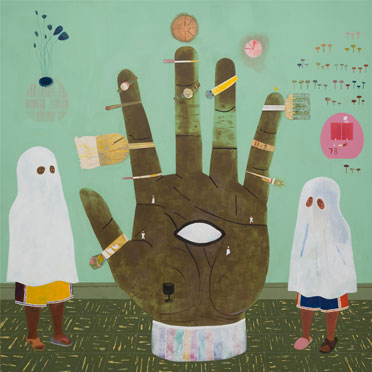
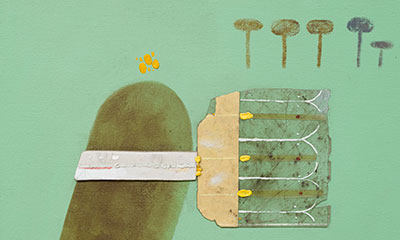
The Japanese artist Chinatsu Ban creates imaginative narratives using a recurring cast of figures, primarily little girls and elephants, and objects, such as apples and ice cream, in her drawings and large-scale acrylic paintings, which initially suggest the whimsy of children’s book illustrations. Since the artist’s childhood, the elephant, which is now her central motif, has been a source of comfort.
Filter by Event Type
- Exhibitions
- Films
- Performances
- Studio Programs
- Lectures
- Tours
- Member Events
- Gallery Programs
- Cafe Modern
- Shop Modern
Filter by Audience
FOCUS: Ralf Ziervogel marks the young German artist’s first solo museum exhibition. Since 2003, Ziervogel has developed a stream-of-consciousness method for creating large-scale, lush panoramic drawings that explore the effects of consumer gratification. In his imagined worlds, societal chaos is constructed on themes of obsessive sex and violence.
Pretty Baby, organized by Curator Andrea Karnes and the Modern Art Museum of Fort Worth, explores various notions of childhood identity in contemporary art. International in scope, the exhibition features approximately sixty works by thirteen artists in various media, including painting, photography, sound, installation, and video.
Barnaby Furnas (American, born 1973) explores historical and biblical themes in his large-scale canvases, which are often described as colorful and expressionistic. The parting of the Red Sea, the Crucifixion, the hanging of the American abolitionist John Brown, and the American Civil War, for example, are depicted by Furnas in dramatic scenes that combine figuration with abstraction. To create his works, the artist places his canvases on the floor and allows pigment to pool and run, forming abstract shapes.
Ron Mueck, a virtuoso of hyperrealistic sculpture, has earned international recognition, with previous major exhibitions in London, Venice, Washington, and Berlin. Over the past decade, the Australian-born, London-based artist has created a personal, distinctive body of works whose startling impact have given a fresh impulse to contemporary sculpture.
Declaring Space includes works by four artists whose images had a dramatic effect on the complex development of space and color in abstract painting as it evolved in the years following World War II. The works of these artists do not represent a movement as much as a dramatic evolution of what has come to be thought of as "the field," an often misunderstood term in the vocabulary of postwar abstract art.
FOCUS: Joshua Mosley features the artist’s high-definition animation short and sculpture installation titled A Vue, 2004. “A vue” is a French rock-climbing term meaning a clean ascent with no knowledge of the route. Like much of his work, A Vue addresses Mosley’s interest in the complex nature of balancing the personal with societal responsibility.
Martin Puryear is a retrospective that features approximately forty-seven sculptures, following the development of Puryear's thirty-year career from his first solo museum show in 1977 to the present day.
Engaging the masculine, machine aesthetic of Minimalism and the equally macho, but gritty, iconography of heavy metal music, Banks Violette creates an unlikely pact between high and low forms of visual communication to explore the ways fiction can turn into belief, or fantasy can be rendered real. Violette’s work is often characterized as an exploration of present-day themes of disaster, driven by stories of teen angst or devotion to—even obsession with—a particular band.
Kehinde Wiley creates larger-than-life-size portraits that mix historical Western European painting styles such as French Romanticism, Rococo, and Baroque with images from contemporary urban streets. The resulting monumental works are painted in Wiley’s characteristic, flamboyant style and presented in ornate gold frames. While the artist evokes important and highly recognizable paintings from the past, he replaces those works’ elite white sitters with African-American men.