Rashid Johnson: Gallery 12
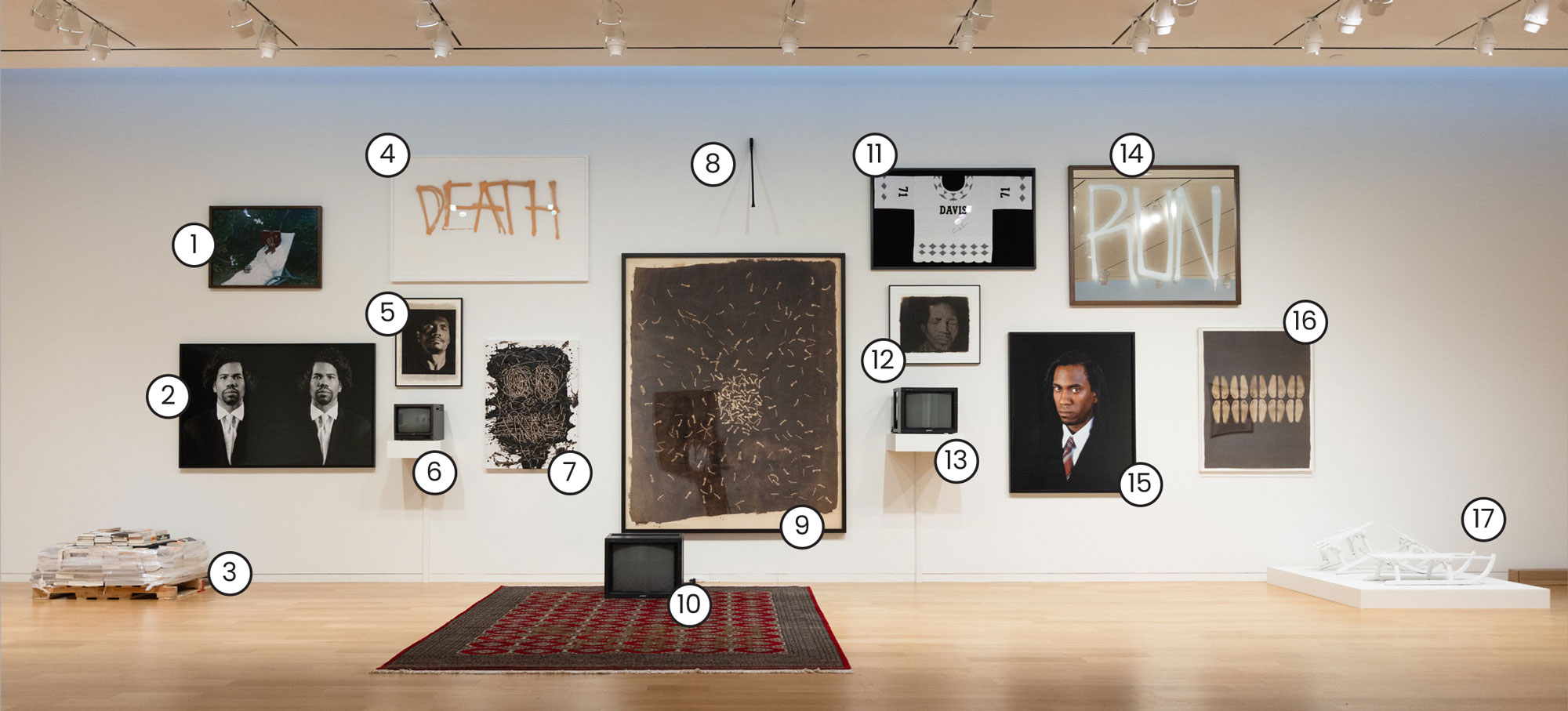
Installation view of works in Rashid Johnson: A Poem for Deep Thinkers
Download a PDF in English | Descargar un PDF en español
Rashid Johnson: A Poem for Deep Thinkers
1. The Reader, 2008
Chromogenic print
Courtesy of Dr. Kenneth Montague | The Wedge Collection, Toronto and Monique Meloche Gallery
2. The New Negro Escapist Social and Athletic Club (Emmett), 2008 (printed 2025)
Chromogenic print
Private collection
3. Contemporary Black Male Literature Starter Kit, 2003–present
Books, plastic wrap, and wood pallet
Dr. Cheryl Johnson-Odim
4. Death is Golden, 2004
Spray enamel on paper
Dr. Cheryl Johnson-Odim
5. Michael, 1998
Van Dyke brown print
Collection of the Artist
6. United Boogie Down Baptist B-Boy Beathouse Crew, 2001
Color video with sound
3 minutes
Avelino Marin Merono
In his debut film, Johnson blends footage of a United Baptist church service, captured on what is known as a “three-chip camera,” with a track by KRS-One and DJ Scott La Rock. In the opening frame, the title appears in both English and Cyrillic characters, intentionally introducing ambiguity regarding the work’s cultural and geographical context. In the process of making this work, Johnson cut frames from the video to align the worshippers’ movements with the rap track, creating a glitch-like synchronicity between their rapture and the beat.
This fusion of church ritual and hip-hop was inspired by the artist’s first visit to the South in Mississippi, where Baptist services evoked the dancerly movements of the hip-hop scene in his native Chicago. In the film’s brief three-minute duration, Johnson manipulates scene, frame, and sound, transforming the service into an experimental, rhythmic experience.
7. Untitled Anxious Men, 2015
Ceramic tile, black soap, wax, and wood panel
Private collection
Inspired by Johnson’s visits to ceramic-tiled bathhouses in search of both self-healing and community, each work in the Anxious Men series begins with a grid of white bathroom tiles. The artist then applies a mixture of melted black soap and wax to the surface, carving into it to create an abstract, noseless face, or spirit, with staring eyes—a visage formed through removal rather than addition.
In Untitled Anxious Men, 2015, Johnson delves into visual expressions of anxiety, particularly in relation to Black masculinity, parenthood, and the systemic failures that leave Black children abandoned and unsupported. This exploration is especially poignant as it occurred in the mid-2010s, a period when high-profile cases of police brutality gained widespread attention. These pieces reflect the artist’s personal struggle to soothe these internal and external anxieties during major life transitions, while also questioning how art can act as a cathartic tool. Drawing from spaces of cleansing, prayer, and relief—such as bathhouses and home environments—Johnson offers both individual and collective release.
8. bLAX, 2005
Steel and stained wood
Private collection
9. Mudcloth, 2001
Van Dyke brown print
N’Namdi Contemporary
10. Black Yoga, 2010
Persian rug, spray enamel, monitor, and color video with sound, transferred from 8 mm film
4 minutes, 42 seconds
Collection of the Artist
While in Germany in his late twenties, Johnson attempted to learn yoga, but because yoga instruction relies heavily on verbal cues, the language barrier prevented him from fully participating. The frustrating but thought-provoking experience ultimately inspired this piece.
Displayed on a monitor atop a Persian rug, the work evokes spaces of contemplation and study, recalling the intellectual environments of W. E. B. Du Bois and Sigmund Freud. In the silent film, a Black man performs improvised movements—a blend of yoga, sharp voguing, and precise martial arts—outdoors in a grassy expanse. Filmed from a distance, he is presented more as an abstract figure than as a person. Just as Johnson was unable to fully access yoga in Germany, the presentation of the film creates a similar sense of remove and detachment. With no personal context beyond his movements, the viewer is left to interpret the man based on their own assumptions.
In a related work—The New Black Yoga, 2011, installed in the upstairs galleries—five Black men perform choreographed movements on a barren beach, a liminal space between land and water. Drawn from ballet, athletics, and martial arts, their gestures create a rich narrative of community and shared movement, in stark contrast to the solitary figure in Black Yoga.
11. Signed Angela Davis “Civil Rights All Stars” Throwback Dashiki Jersey, 2003
Embroidered cloth shirt with ink signature mounted on fabric, plexiglass, and wood display case
Collection of the Blanchard Nesbitt Family
12. Jonathan with Eyes Closed, 1999
Van Dyke brown print
Paul and De Gray
13. Me, Tavis Smiley and Shea Butter, 2004
Color video with sound
1 minute, 57 seconds
Avelino Marin Merono
This video captures the artist in a bathroom, where he is moisturizing his body with shea butter while listening to The Tavis Smiley Show, the first NPR program hosted by a Black person. For Johnson, listening to Smiley’s show was a daily ritual of self-care, and in this video, shea butter—one of Johnson’s signature materials—plays a central role. The artist’s use of shea butter also critiques the commodification of a substance deeply embedded in African cultural traditions, especially within the Black diaspora, for whom it is a symbol of the homeland.
Filmed in what’s known as the Dogma style, with its strict adherence to realism, rejection of special effects, love of natural lighting, handheld camera work, and unscripted performances, the video blurs the lines between private ritual and public performance. The bathroom, a domestic space, becomes a manifestation of the artist’s interiority while also embodying the intersection of intimate rites, consumer goods, and media consumption. This gesture echoes Bruce Nauman’s video Art Make-Up, 1967–68, which explores identity and transformation through performative self-painting, and William Pope.L’s performance I Get Paid to Rub Mayo on My Body, 1991, which extends Nauman’s work by incorporating questions of value and class.
14. Run, 2008
Spray enamel on mirror
Nancy Delman Portnoy Revocable Trust
15. Self-Portrait with My Hair Parted Like Frederick Douglass, 2003 (exhibition copy, 2025)
Lambda print mounted on Sintra
Collection Museum of Contemporary Art Chicago, Gift of the Susan and Lewis Manilow Collection of Chicago Artists
Functioning as both a self-portrait and an homage, this early photograph positions Johnson as a contemporary iteration of Frederick Douglass, one of the most photographed figures of the 1800s. The use of digital color in this work contrasts with the Van Dyke brown photographic process typical of the nineteenth century, as well as with the artist’s other prints, Mudcloth, 2001, and Manumission Papers, 2001. Through playful mimicry and call-and-response—traditions rooted in gospel services—the artist attempts to replicate Douglass’s pose and parted hairstyle, a look so uncommon today that it verges on the humorous.
As one of Johnson’s first self-portraits as a historical figure, this piece exemplifies his early journey of self-education, both as an emerging artist and as a Black subject within a broader sociopolitical context. The monotone background and close crop force the viewer to confront Johnson’s direct gaze, inviting a deeper engagement with the photograph. In the history of portraiture, the direction of a subject’s eyes often signifies the level of desire to connect with the viewer. This performative self-portrait lays the foundation for the artist’s future explorations of representation.
16. Manumission Papers, 2001
Van Dyke brown print
Paul and De Gray
17. Homage to Chinua Achebe IV (Fela Kuti “Zombie”), 2004
Acrylic on wood and metal with audio CD
The Speyer Family Collection, New York
At times, Johnson adopts what art historian Sampada Aranke calls a “citational” approach, using historical, literary, and cultural references that invite the viewer to make associations or initiate reflection. In this notable piece, the artist evokes a 1977 incident in which Funmilayo Ransome-Kuti, a Nigerian women’s rights activist, was thrown from a second-story window during a raid by the military in that country. The attack followed tensions sparked by her musician son Fela Kuti’s album Zombie (1976), which criticized the military government of Nigeria, referring to its soldiers as “zombies.”
In Johnson’s sculpture, this event becomes a powerful symbol, linking Chinua Achebe’s novel Things Fall Apart (1958), about the act of resistance under colonialism, and Marcel Duchamp’s artwork Standard Stoppages, 1913–14, which incorporates the fragments of materials dropped from a great height to form new works.
The two sleds in Johnson’s work—one undamaged, the other severely altered—echo Joseph Beuys’s work The Sled, 1969, in which materials like lard, felt, and torches symbolize survival, rescue, and the transmission of knowledge. This work reflects Johnson’s concept of “poly-consciousness,” or engagement with multiple perspectives, references, and cultural histories simultaneously.