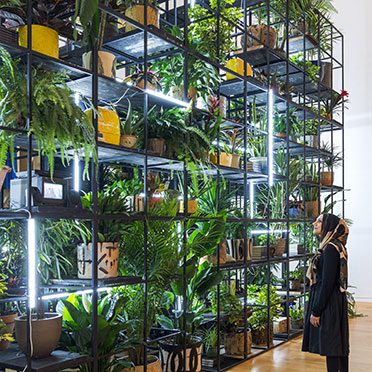
Richard Wentworth

Richard Wentworth has been a leading figure in New British Sculpture since the late 1970s. Celebrated as an art intellectual, Wentworth has long been respected as an artist, writer, teacher, and curator. His work has been featured in significant exhibitions including the 50th Venice Biennale and Global Cities at the Tate Modern. He is also readily recognized for organizing Thinking Aloud, the critically acclaimed exhibition that opened at the Hayward Gallery in 1999 and followed with a national tour.

Rosson Crow

Rosson Crow is an artist living and working in Los Angeles. Crow’s large-scale, raucous paintings have been described as “inspired by diverse references—Baroque and Rococo interior design, cowboy culture, Las Vegas architecture, theatre, and music—their dominant scale pulling the viewer into the psychological space of the spectacle. These paintings oscillate between celebration and desolation.” This Tuesday Evenings presentation serves to set up the Modern’s FOCUS: Rosson Crow, which opens the following weekend.

Wayne White

Wayne White is a Los Angeles-based artist. Having begun his career as a production designer for Pee-Wee’s Playhouse, White is now recognized for his clever and beautifully rendered text paintings. As a wordsmith and draftsman extraordinaire, White juxtaposes irreverent and humorous phrases with the pastoral scenes of existing thrift-store paintings to create something all together new and always compelling.

Stephen Lapthisophon

Stephen Lapthisophon is an artist and educator living and working in Dallas. A student of art history, comparative literature and theory, poetry, film and the sensory world, Lapthisophon’s work varies in form from found objects to images, installations, performances, and sound. His work has been described as “layers of meanings, allusions, and associations.” (Kathryn Hixson, Frieze) For Tuesday Evenings, Lapthisophon presents his work as it confronts and demonstrates means of communication through art. 

Susan Rothenberg

Susan Rothenberg is in conversation with Michael Auping.  Prior to the opening of the exhibition Susan Rothenberg: Moving in Place, the artist and curator of the exhibition discuss the development of Rothenberg’s imagery, from the ground-breaking early horse paintings of the mid-1970s to her fragmented and spinning self-portraits. The artist will also discuss the influence of her move from New York to New Mexico in 1990 and the effect of that landscape/environment on her palette as well as the suggestion of narrative in her subsequent work.

Wellington Reiter

Wellington Reiter, FAIA, is currently the President of the School of the Art Institute of Chicago. Reiter’s professional practice is Urban Instruments, Inc., and his work ranges from drawings to museum installations and built structures. His projects include the Wright Brothers monument in Raleigh-Durham, North Carolina, and the entry pavilion to the DeCordova Museum and Sculpture Park in Lincoln, Massachusetts. His drawings of speculative urban conditions were included in the 2008 Venice Biennale for Architecture.

William Lamson

William Lamson is a Brooklyn-based artist recognized for an inventive body of work that, as described on National Public Radio, uses “inexpensive materials and simple structures” to create “visuals that are mesmerizing and, in a word, playful.” Addressing issues of masculinity, amateurism, science, play, and the quixotic quest for personal heroism, Lamson speaks to the spirit of ingenuity in sculptures, photographs, and performances that broaden horizons and entertain the imagination.

Tony Scherman

Tony Scherman is a Canadian artist renowned for his encaustic paintings found in collections throughout North America and Europe. Erudite and passionate, Scherman brings a wealth of research and a tremendous facility for painting to his melancholic portraits that press hard into the space of the viewer. As Lilly Wei explains in the exhibition catalogue About 1865, “Scherman has an impulse to destabilize precedents, to seek transformations and to view ideologies with skepticism, to be conceptually vigilant.